

From Seasonal Encampment to
a Home for Regional Scholarship
For nearly three thousand years, the Love House site has held the stories of southern peoples.
Long before Chapel Hill existed, Indigenous people made camp here seasonally, leaving behind pottery and tools.
Following a dig by university archaeologists in 2004, Jon Marcoux, Director of UNC’s Research Laboratories of Archaeology, observed, “While the historic landscape of the Southeast [during that time] was incredibly dynamic . . . it is certainly appropriate to refer to the people who lived on the land where the Love House is now located as the ancestors of today’s tribal communities across North Carolina.” Pottery fragments and projectile points date the encampment from 800 BCE to 800 CE, making it one of the earliest known Indigenous sites in this region.
After the University of North Carolina was founded in the 1790s, this land became part of the village of Chapel Hill.
In 1812, a home was built on the property for the university president. The house burned in the 1880s, and James Lee Love, a UNC alumni and mathematics professor, rented part of the property and built a house for himself and his wife Julia “June” Spencer Love, as well as her mother, Cornelia Phillips Spencer, a local artist and writer. Described as a “confounding and paradoxical figure” in UNC history, Spencer was a vocal conservative who supported both the state’s white supremacist Democratic Party and the postwar reopening of UNC as key to rebuilding the local economy.
The last family member to live in the Love House was Spencie Love, the granddaughter of James and June Love, and a daughter of Spencer Love. A journalist, historian, and writer who worked with the Southern Oral History Program, Spencie Love played a key role in preserving the property before UNC formally repurposed it.
Significant support for the renovation of the Love House and an addition, the Hutchins Forum, came from the Love Foundation and Glen Hutchins in honor of his father, James. A. Hutchins Jr., UNC Class of 1937. James Hutchins studied under sociologist Howard Odum and worked on important international hunger and poverty-alleviation initiatives.
CSAS
In 1992, the UNC Board of Governors established the Center for the Study of the American South to confirm Carolina’s long-standing commitment to its own region.
In 2007, the Love House became the home of the Center for the Study of the American South. Henry Louis Gates Jr., distinguished scholar of African American history at Harvard University, gave the dedication on April 21, 2007, to a gathering of Center friends, colleagues, and campus and community dignitaries.
Today, the Love House stands as a layered symbol—built on Indigenous land, shaped by generations of white and Black North Carolinians, and now a place of collaboration and inquiry into the South’s histories and futures. At UNC, southern identity is both incidental and inescapable, intimate and contested. To study the South is to reckon with its contradictions—its legacies of power and exclusion and its capacity for reinvention. There is always more to uncover, more to reconcile, and more to question.
Read more of Ellen Saunders Duncan’s history of the Love House here.
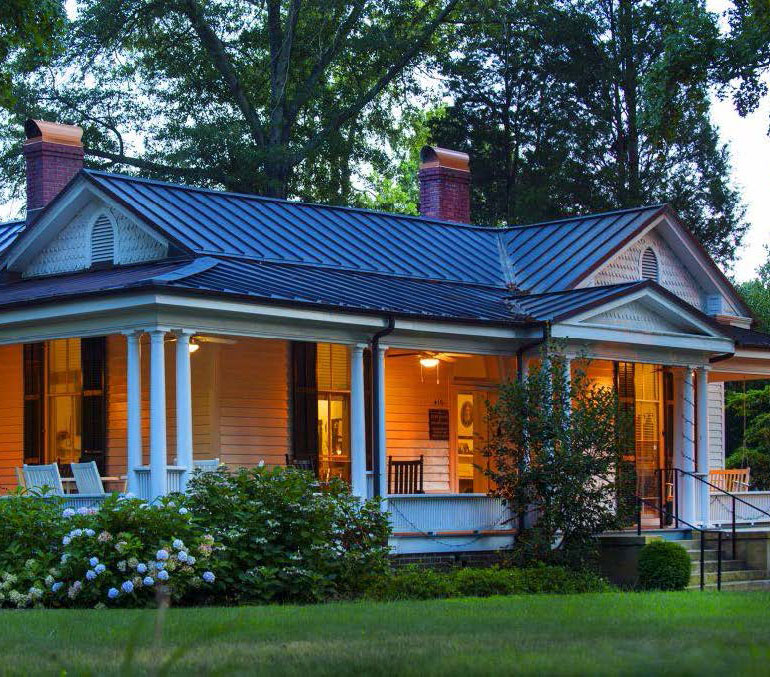

The front porch of the nation’s first public university.